

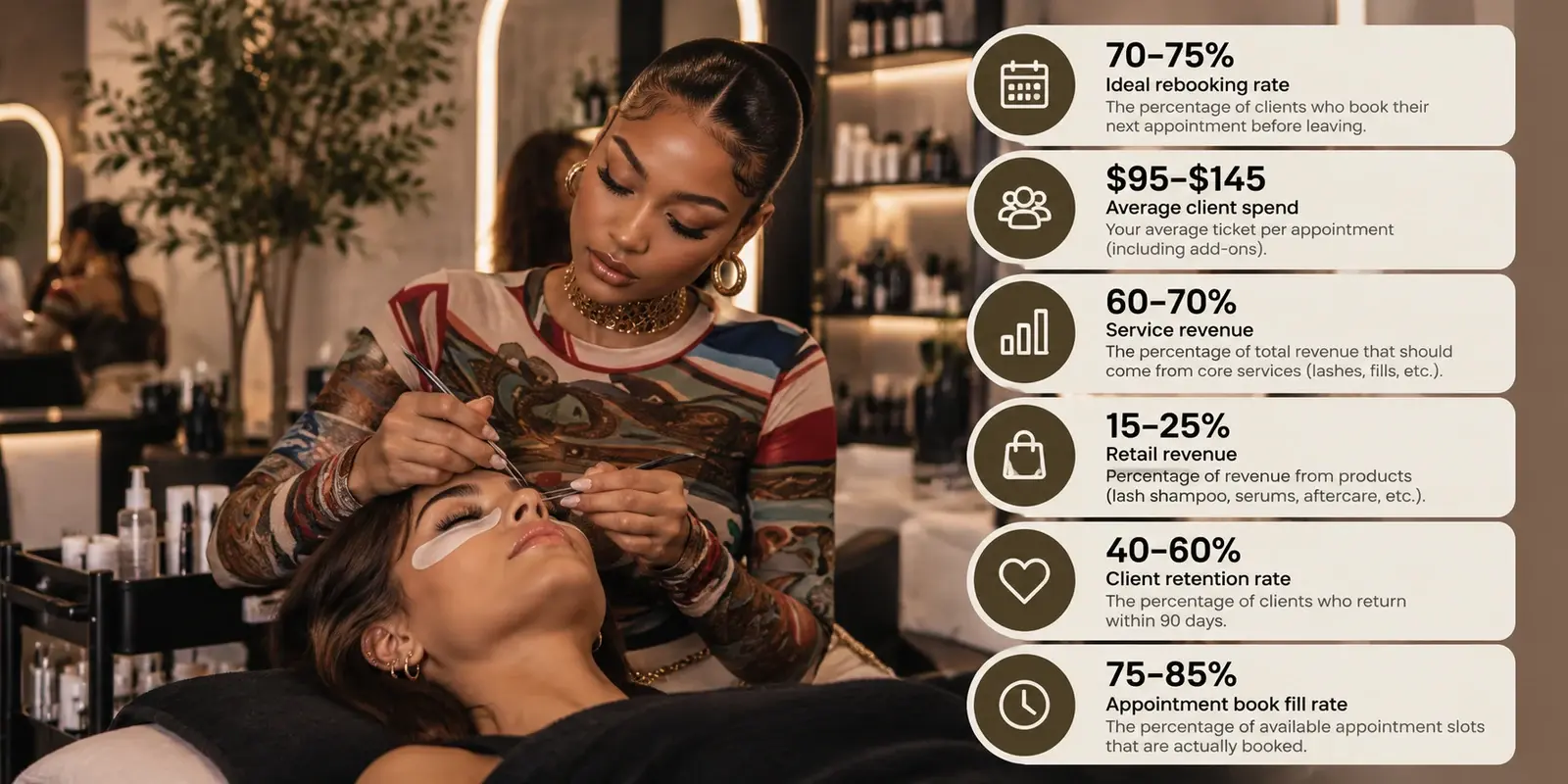
You can’t fix what you don’t measure. These salon metrics show whether your business is healthy, where revenue is leaking, and which numbers to watch every month, whether you run a salon, spa or beauty studio.
Total Revenue
Start with the obvious.
Track revenue monthly and compare it with previous months and the same period in prior years. Look at the trend rather than one isolated number.
Average Ticket
Average ticket tells you how much the average client spends per transaction. Total revenue ÷ number of transactions = average ticket
Increasing average ticket can grow revenue without requiring additional appointments.
Client Retention
How many clients actually come back?
A business that constantly attracts new clients but loses existing ones has a retention problem, not simply a marketing problem.
Track both overall retention and first time client retention.
Rebooking Rate
Rebooking measures how many clients schedule their next appointment before leaving or within a defined period.
A strong rebooking rate creates more predictable future revenue and helps providers build consistent books.
No Show and Cancellation Rate
Track how much of your calendar disappears because of late cancellations and no shows. Then take it one step further.
Calculate the revenue associated with those missed appointments.
A small percentage can translate into a surprisingly large amount of lost revenue over a year.
Utilization
How much of your team’s available appointment time is actually being booked?
An employee who is available for 40 hours but only booked for 22 service hours has unused capacity.
Understanding utilization can help you make better decisions about hiring, scheduling, marketing, and operating hours.
Labor Cost
Track labor as a percentage of revenue.
Your business can grow sales while becoming less profitable if payroll grows even faster. Looking at labor alongside revenue gives you a much clearer picture.
Revenue Per Provider
Looking at individual provider revenue can help identify differences in utilization, average ticket, rebooking, and overall performance.
The goal is not simply to compare employees.
The data can help you identify where coaching, training, or additional support may be needed.
Revenue Per Location
For multi location businesses, company wide numbers can hide underperforming locations. Review each location independently.
One location may have strong revenue but high labor costs while another has lower revenue but healthier margins.
Profit
Finally, know what you actually keep. Revenue might be an exciting number.
Profit is the number that determines whether your business is financially healthy.
Your Numbers Tell You What to Do Next
Data should not just sit inside a report. It should help you make decisions.
When you understand what is happening with retention, bookings, labor, average ticket, cancellations, utilization, and profitability, you stop relying on gut feeling alone.
You can see what is working, what is not, and where your attention should go next.
Emvari gives beauty and wellness business owners greater visibility into the information behind their day to day operations, helping turn appointment and client data into information they can actually use.
If you’re new to reading the numbers, the SBA’s guide to managing small business finances is a good plain-English starting point for balance sheets and cash flow.
Your Monthly Salon Metrics Scorecard
You do not need to check every number every day. A simple rhythm keeps it manageable:
Daily: revenue, appointments completed and no-shows.
Weekly: utilization by provider, rebooking rate and upcoming open time.
Monthly: average ticket, client retention, labor cost as a percentage of revenue, retail sales and profit.
Quarterly: revenue per location, service mix and pricing.
Put the monthly numbers on one page and compare them with the previous month and the same month last year. Patterns become obvious fast when the numbers sit side by side.
How to Act on Salon Metrics
Every metric should lead to a decision. If utilization is low on Tuesdays, run a promotion or adjust staff hours. If rebooking is low for one provider, coach checkout conversations. If labor cost is rising faster than revenue, review commission structures or scheduling.
Pick one or two numbers to improve each quarter instead of trying to fix everything at once. Focused effort moves numbers. Spreading attention across ten metrics usually moves none of them.
Common Mistakes When Tracking Salon Metrics
Numbers only help when they are accurate and read in context. One common mistake is comparing a single month with the month before without accounting for seasonality. December and January rarely look alike. Compare each month with the same month last year as well.
Another mistake is tracking revenue without tracking costs. A month with record sales can still be a weak month if labor or discounts grew faster. And many owners rely on numbers that are entered by hand, which leads to gaps and errors.
Finally, avoid tracking more than you can act on. A short list of metrics reviewed consistently will do more for your business than a long report nobody reads.
Frequently Asked Questions
What are the most important salon metrics?
Start with revenue, average ticket, rebooking rate, client retention, utilization and labor cost. Together they show whether you are growing, keeping clients and running profitably.
How do I calculate salon utilization?
Divide booked service hours by available service hours. A stylist available for 40 hours and booked for 30 has a 75% utilization rate.
Do I need software to track salon KPIs?
You can track them in a spreadsheet, but it takes time and is easy to fall behind on. Salon software that records every appointment and sale can calculate most of these numbers automatically.
How often should I review my salon metrics?
Check a few numbers daily, like revenue and no-shows, review utilization and rebooking weekly, and do a fuller review monthly. Set a regular time on your calendar so it actually happens.
Track Your Salon Metrics With Emvari
Emvari’s salon reporting dashboard tracks these numbers automatically, including revenue, average ticket, retention and rebooking rate by stylist, so you’re not building spreadsheets at night.